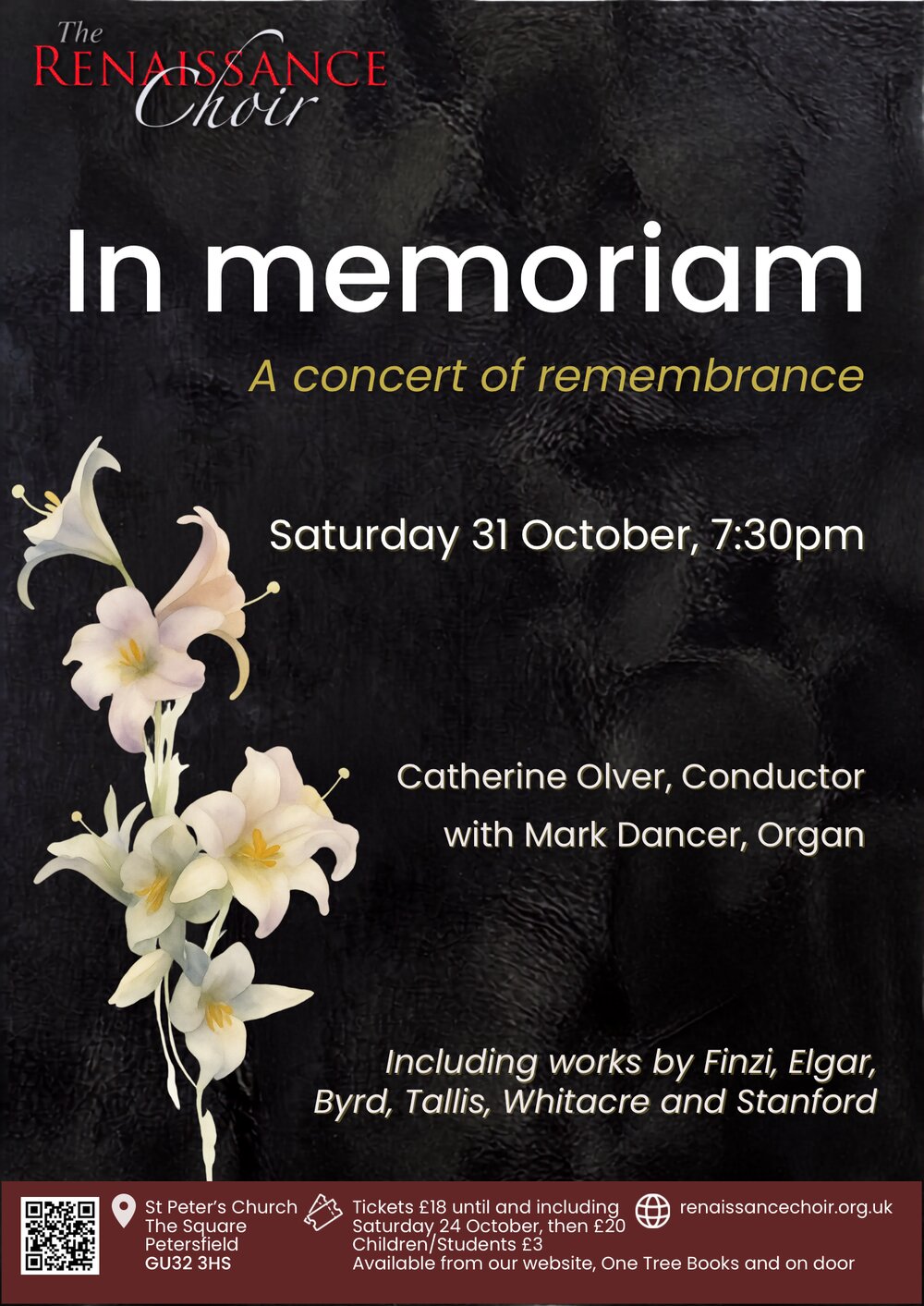
‘In memoriam’, as its title suggests, focuses on our memory of loved ones who are sadly no longer with us.
Catherine Olver and Geoffrey Whittington tell us more about the concert on Saturday 31 October at St Peter’s, Petersfield.
Douglas Guest (1916 – 1996) – For the Fallen
This short anthem was written in 1971 for the Remembrance Day service at Westminster Abbey. The music provides a peaceful backdrop to Laurence Binyon’s poignant wartime text.
Thomas Tallis (1505 – 1585) – Hear the voice and prayer
Thomas Tallis was one of the great pioneering English Renaissance composers. Tallis was employed by the Chapel Royal, serving four Tudor monarchs from 1543. During his lifetime, Tallis was a skilled organist, but he is arguably best remembered for his contribution to sacred vocal music, particularly with his 40-part motet ‘Spem in alium’.
Tonight’s anthem, which was composed during the reign of King Edward VI, is written for a much smaller SATB ensemble. In line with the views of the Protestant reformers at the time, the word setting is mainly syllabic to ensure that the meaning of the text was not obscured by the music.
William Byrd (1540 – 1623) – Mass for four voices
One of the greatest composers of the Renaissance, the English composer William Byrd produced some of the era’s finest examples of vocal and instrumental music, writing both sacred and secular works. Like Thomas Tallis, he wrote music for the “new vernacular” (later known as Anglican) services, despite being a devout Catholic. It is worth noting that, in Elizabethan England, performance of any Catholic work was banned. Byrd, therefore, had to be very careful, often writing for sympathetic Catholic families with secret performances in country houses.
Byrd’s three mass settings were published between 1592 and 1595, and they have retrospective features of the earlier Tudor mass style. This four-part mass is probably the best known, with its well-shaped melodic lines serving the meaning of the text.
Sir Arthur Somervell (1863 -1937) – ‘Adagio’ from Two Conversations about Bach
Somervell was born in the Lake District, the youngest son of the founder of a prominent shoe manufacturer. He was educated at Uppingham and King’s College, Cambridge. He went on to study in Berlin and later at the RCM under Parry. From 1901, he was Inspector of Music to the Board of Education, becoming Principal Inspector in 1920, campaigning for music to be available to all children as a key part of the school curriculum, for which he was knighted on retirement.
The Two Conversations about Bach are originally for two violins and piano. The ‘Adagio’ (the first of the pair) is based on an ostinato bass line, with imitative writing for the violins above. This arrangement is by Jonathan Scott and, without losing the intimate character of the original, makes full use of the organ rather than simply turning it into just another trio sonata movement.
Sir William Harris (1883 – 1973) – Bring us, O Lord
Sir William Harris was an English organist and composer. He was organist at Lichfield, Oxford and lastly at St George’s Chapel, Windsor. He also conducted the Bach Choir, was professor at the RCM and wrote works for the 1937 and 1953 coronations. After Windsor, Harris and his wife retired in 1961 to live in Petersfield up to his death.
This work, composed in 1959 to words by John Donne, is a very rich eight-part double choir work with striking harmonic shifts.
Eric Whitacre (b.1970) – Sleep
The American contemporary composer Eric Whitacre is now one of the most popular living composers in the world. This choir has been performing his pieces since they first became available in the UK and are a key part of our repertoire. Whitacre brings highly unusual note-clusters and wonderfully fresh sonorities. These qualities can be heard in ‘Sleep’ which, based on text by Charles Silvestri, beautifully illustrates the process of falling asleep.
Sir Edward Elgar (1857 – 1934) arranged by John Cameron (b. 1944) – Lux Aeterna
John Cameron (born 1944) is a British composer, arranger, conductor and musician who contributed to many films and was associated with Donovan and the group Hot Chocolate. He made this eight-part vocal arrangement of the famous ‘Nimrod’ theme from Edward Elgar’s ‘Enigma Variations’. This vocal arrangement was performed by VOCES8 as a tribute on Armistice Day 2016.
Tomás Luis de Victoria (1548 – 1611) – Jesu, dulcis memoria
Tomás Luis de Victoria was an eminent Spanish composer of the Renaissance and is a mainstay of our programmes. Although his life began and ended in Spain, he spent much of his early career in Rome. His music is fresh and expressive, as exemplified in tonight’s motet, which is new to many of us.
C.V. Stanford (1852 – 1924) – ‘Beati quorum via’ and ‘Justorum animae’ from Three motets
Charles Villiers Stanford was a leading Irish composer, organist, teacher and conductor. Besides being organist at Trinity College in Cambridge, Stanford was later appointed Professor of Composition at the Royal College of Music in London and then Professor at Cambridge. Besides operas, symphonies and works for large choir, Stanford contributed a great deal to Anglican music.
These two motets from his op. 38 collection are fine examples of his writing; ‘Beati Quorum via’ builds up a tapestry of flowing melodic lines before reaching a hushed section in the middle, whilst ‘Justorum animae’ is bolder with dramatic dynamic changes and chromatic harmony.
Sir Charles Hubert Hastings Parry (1848 – 1918) – Chorale Fantasia on ‘O God, our help’
Parry was a hugely prolific composer, writing in virtually every genre – opera, oratorio, symphony, incidental music, part-songs, chamber music, you name it. His idiomatic organ writing has long been popular among organists, being carefully crafted and generally lying well under the hands and feet.
This Chorale Fantasia is the first of a set of three larger scale hymn-tune settings published in 1915, taking as its basis the well-known hymn tune St Anne. It makes good use of the angular opening phrase of the tune, weaving it into a complex texture of syncopation and three-against-two counterpoint over which the melody is heard in long notes.
Sir Edward Bairstow (1874 – 1946) – Let all mortal flesh keep silence
Sir Edward Bairstow was an organist and composer, born in Huddersfield. After studying at Durham and holding posts in Wigan and Leeds, he was organist of York Minster for 33 years. Amongst his pupils was Gerald Finzi, whose music is also featured in tonight’s programme. Bairstow mainly wrote for the church, composing 29 anthems and several services.
Written in 1906, this is considered one of his best-known anthems, demonstrating considerable power and interest in the bass line by means of a walking bass on the words ‘the cherubim with many eyes’.
Gerald Finzi (1901 – 1956) – Lo the full, final sacrifice
Gerald Finzi was one of the key English composers of the first half of the twentieth century. For some years, Finzi lived in Hampshire and conducted the Newbury String Players.
This festival anthem for choir and organ was written in 1946 and dedicated to Walter Hussey, then incumbent at St Matthew’s, Northampton (later to be Dean at Chichester Cathedral). It sets words by Richard Crashaw from text by Thomas Aquinas.
Finzi’s musical setting presents the words in a way that aligns with the natural speech rhythms and the subtle harmonic dissonance adds further intensity to the meaning. Listen out for some haunting chorus sections, beautifully crafted solos, and a final amen stretched to eight parts.